

If your business stores food, vaccines, samples or anything that must be kept within a tight temperature range, you are already doing temperature monitoring – the question is whether you are doing it the hard way or the smart way.
A temperature data logger takes automatic readings all day and night, stores them with date and time, and gives you proof of what really happened. Instead of relying on a quick glance at a thermometer and a scribble on a clipboard, you get a full story.
If you have not seen it yet, this article sits nicely after “What is a temperature data logger and how does it work?”, which explains the basics.
In a lot of businesses, fridges and freezers “have always been fine”, right up until the day they are not.
Common real-world issues include:
If you are only checking temperatures once or twice a day, you will never see those events. By Monday morning, everything might look fine on the display, but the damage has already been done.
A temperature logger does not rely on someone remembering to check. It quietly tracks every rise and fall, so you can see if stock has been kept within a safe range the whole time, not just at inspection time.
Most businesses start with manual checks because they are cheap and simple on paper. Over time, the cracks show.
Manual logs often suffer from:
It is not that staff are lazy – they are juggling a lot, and temperature logging is easy to push down the priority list.
A temperature logging system:
Staff still have a role – they act on alerts and check equipment – but they no longer have to be human data loggers.
For many industries, it is not enough to keep things at the right temperature – you have to be able to prove that you did.
A temperature logger helps you:
When there is a complaint, recall or investigation, being able to produce reliable temperature records can make a huge difference. Instead of digging through folders of handwritten sheets, you can pull up a PDF in seconds.
A single fridge failure can cost more than an entire monitoring system.
Think about:
Without proper logging and alerts, you might only discover a problem when someone opens the door at 7 am and finds everything warm.
With a temperature logging system that includes alerts, you can:
It is not about never having equipment failures – it is about catching them early enough to reduce the damage.
Temperature control is not just a technical requirement, it is a safety issue.
A temperature logger helps you:
When you can see a clear history of temperatures, you are not guessing about safety – you are making informed decisions.
From a staff point of view, manual temperature checks can feel like a chore that adds no value. They are repetitive, and no one notices when they are done properly – but everyone notices when a sheet goes missing.
A temperature logging system:
You can still keep a simple daily check if your procedures require it, but the heavy lifting is done in the background.
You may be ready to move to automatic logging if:
In many businesses, the tipping point is when the cost and hassle of manual logs quietly add up to more than the cost of a decent monitoring system.
You do not have to overhaul everything at once. A simple way to begin is:
From there, you can move towards a full monitoring system – like Clever Logger – that covers all your key fridges, freezers and rooms, and gives you one place to see what is going on.

The National Association of Testing Authorities (NATA) is the recognised national accreditation authority for analytical laboratories and testing service providers in Australia. It is an independent, not-for-profit organisation that provides independent assurance of technical competence.
NATA accredits organisations to perform testing and inspection activities for their products and services. This gives consumers the assurance they need to make safe, healthy and reliable choices .
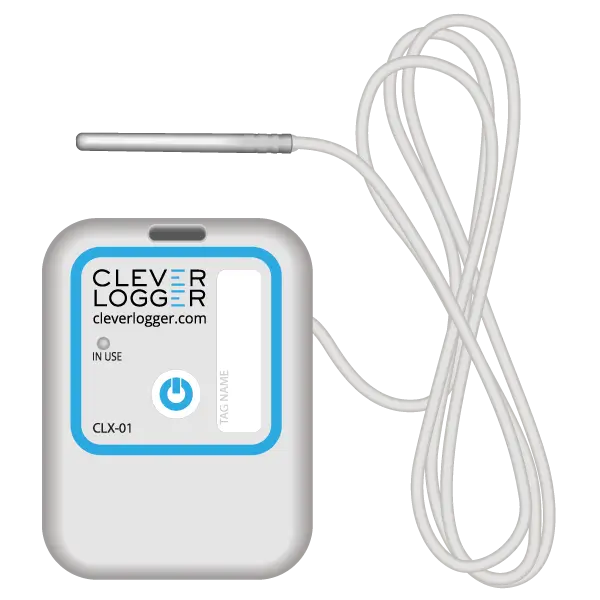
| QUICK SPECS | |
|---|---|
| Model | CLD-01 |
| Type | Temperature only with Dual Sensors |
| Temperature Range | Internal sensor: -23°C to +60°C External sensor: -40°C to +80°C |
| Humidity Range | N/A |
| Battery Type | CR2450 |
| Battery Life | Replace every 12 months |
| Accuracy |
Internal Sensor: ±0.3℃ (0℃ to +60℃) ±0.3℃ to ±0.7℃ (other temperatures) External Probe: ±0.5℃ (-20℃ to +40℃) ±1℃ (other temperatures) |
| Offline Memory | approx 24 days logging at 5 minute intervals |
| QUICK SPECS | |
|---|---|
| Model | CLX-01 |
| Type | Temperature only with Probe |
| Temperature Range | -40°C to 60°C Can operate up to 80°C for short periods |
| Humidity Range | N/A |
| Battery Type | CR2450 |
| Battery Life | Replace every 12 months |
| Accuracy | ±0.5℃ (-20℃ to +40℃) ±1℃ (other temperatures) |
| Offline Memory | approx 24 days logging at 5 minute intervals |
To prove it, we’ll send you a Starter Kit to try out for a whole month.
Set it up, have a play, explore the features – obligation free.
If you love it, just let us know.
If not, just send it back.