

How often should I record fridge and freezer temperatures?

SEE ALL TOPICS
CLOSE
The Guide logo
Your Account

ON THIS PAGE

In Australia, the gold-standard guidance for vaccine storage is the National Vaccine Storage Guidelines – Strive for Five.  These guidelines say that purpose-built vaccine refrigerators must have continuous data logging set to a minimum of 5-minute intervals, and that data loggers must be capable of recording at 5-minute intervals when purchased. Even though Strive for Five is written for vaccines, the logic behind that 5-minute interval is spot on for food safety fridges and freezers as well. It hits a sweet spot between:
  • Too slow – long gaps where you can easily miss short but important temperature excursions
  • Too fast – so many readings that you drown in data and make life harder than it needs to be
So, a really practical rule of thumb is:
Set your automatic temperature loggers to record every 5 minutes for both vaccine and food fridges and freezers.
Manual recording (twice-daily or similar) can sit alongside that if your procedures require it, but it should never be your only line of defence.

Why Strive for Five recommends five-minute intervals

Strive for Five makes two important points about data loggers:

  • Immunisation providers must have a downloadable data logger or automated system that continuously measures fridge temperature at minimum 5-minute intervals.
  • When buying a logger, it must be capable of recording at 5-minute intervals and storing the temperature data.

This isn’t an arbitrary number. It’s based on real-world experience with vaccine fridges:

  • Temperatures can creep out of range surprisingly quickly if the door is left open, stock is overloaded or the fridge fails.
  • Catching those excursions early depends on frequent enough readings to show the spike clearly on the graph.

If you only log every 30 or 60 minutes, you might see nothing more than a slightly higher reading and never realise the temperature was out of range for 20–25 minutes in between.

Why five minutes is a sweet spot

Think about three different settings for a logger:

1. Logging every 60 minutes – too slow

  • You only get 24 readings per day.
  • Short excursions (door left ajar for 20 minutes, power blip, thermostat glitch) can easily fall between readings.
  • When you review the graph, it might look fine even though stock has had a risky “warm holiday”.

2. Logging every 1 minute – overkill for most sites

  • You get 1,440 readings per day, per fridge.
  • The graph becomes very “busy”, and reports are heavier to store, download and review.
  • For most fridges, the extra safety compared with 5-minute logging is tiny.

3. Logging every 5 minutes – just right

  • You get 288 readings per day – plenty to clearly show any temperature rise or fall.
  • You can see the shape of an event (how fast it went up, how long it stayed high, when it recovered).
  • Data files are still manageable and easy to review and store.

That’s why Strive for Five lands on 5-minute intervals as the minimum standard for continuous logging – it’s a practical balance between safety and noise.

The same logic applies to food safety fridges and freezers

While Strive for Five is all about vaccines, the basic physics is exactly the same for:

  • Café and restaurant fridges
  • Walk-in cool rooms
  • Freezers for meat, seafood, ice cream and prepared meals
  • Aged-care and hospital kitchens

Food doesn’t know whether it’s in a “vaccine fridge” or a “food fridge” – if it warms up, bacteria can grow. If it freezes when it shouldn’t, quality and safety can be affected.

Using 5-minute automatic logging in food fridges gives you:

  • Enough detail to see when doors are left open during service
  • Clear evidence of what happened overnight and on weekends
  • Good data for HACCP verification and audits
  • The ability to respond quickly if your system includes alerts

So even though the guideline was written for vaccines, the risk management logic transfers neatly to food safety.

Why manual logging is fraught with danger

Strive for Five still requires twice-daily manual checks of vaccine fridges – but those checks sit on top of continuous logging, not instead of it.

That’s because relying on manual logging alone is risky:

  • Gaps in time – checking at 9 am and 3 pm tells you nothing about what happened at midnight.
  • Human factors – people get busy, forget, copy yesterday’s number, or write “OK” because it “looked fine”.
  • No duration information – a single reading of 9 °C doesn’t tell you whether it was 9 °C for 5 minutes or 5 hours.
  • Missing records – paper sheets go walkabout or get coffee spilled on them right before an audit.

Even health departments point out that data loggers provide 24/7 monitoring and are essential for working out how long vaccines have been out of range, something twice-daily checks simply can’t do.

Exactly the same issues apply in a kitchen, bar, bakery or aged-care facility. Manual logs on their own will always leave blind spots.

A practical approach for your fridges and freezers

Putting all of this together, a sensible, Strive-for-Five-style approach for both vaccines and food is:

  1. Install automatic loggers on all critical fridges and freezers.
  2. Set the logging interval to 5 minutes – matching the national guideline for vaccines.
  3. Turn on alerts (email or phone app) so you’re notified quickly when temperatures go out of range.
  4. Keep simple manual checks (for example, twice daily) if your procedures or auditors expect them – but treat these as a quick visual check, not your primary record.
  5. Regularly review graphs and reports so you can spot patterns (like doors being left open during certain shifts).

With that setup, you’re not drowning in unnecessary data, but you’re also not gambling on once-or-twice-daily readings. You’re following the same risk-based thinking that sits behind Australia’s own Strive for Five guidelines – just applying it to everything in your cold chain, not only vaccines.

If you like, next we can do a short companion article aimed specifically at vaccine providers, or one aimed at cafés and restaurants, both explaining why “every 5 minutes” is the standard you should be aiming for.

What is NATA?

The National Association of Testing Authorities (NATA) is the recognised national accreditation authority for analytical laboratories and testing service providers in Australia. It is an independent, not-for-profit organisation that provides independent assurance of technical competence. 

NATA accredits organisations to perform testing and inspection activities for their products and services. This gives consumers the assurance they need to make safe, healthy and reliable choices .
Clever Logger temperature logger with external probe

Logger with Dual Temperature Sensors

QUICK SPECS
Model CLD-01
Type Temperature only with Dual Sensors
Temperature Range Internal sensor: -23°C to +60°C
External sensor: -40°C to +80°C
Humidity Range N/A
Battery Type CR2450
Battery Life Replace every 12 months
Accuracy Internal Sensor:
±0.3℃ (0℃ to +60℃)
±0.3℃ to ±0.7℃ (other temperatures)
External Probe:
±0.5℃ (-20℃ to +40℃)
±1℃ (other temperatures)
Offline Memory approx 24 days logging at 5 minute intervals
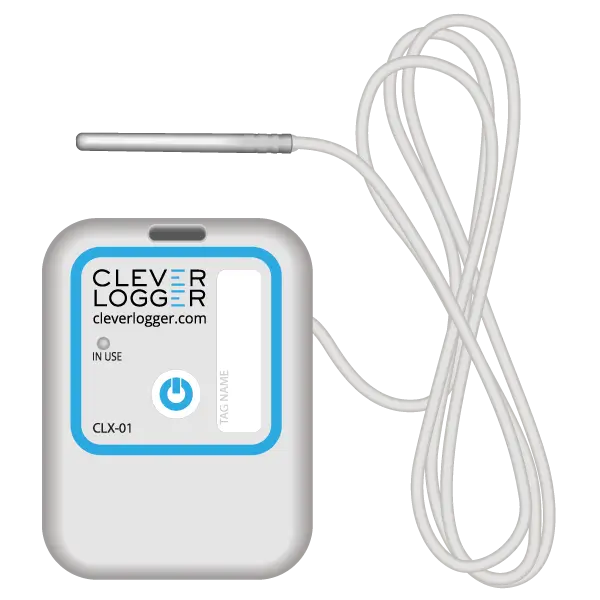
Clever Logger temperature logger with external probe

Logger with External Probe

QUICK SPECS
Model CLX-01
Type Temperature only with Probe
Temperature Range -40°C to 60°C
Can operate up to 80°C for short periods
Humidity Range N/A
Battery Type CR2450
Battery Life Replace every 12 months
Accuracy ±0.5℃ (-20℃ to +40℃)
±1℃ (other temperatures)
Offline Memory approx 24 days logging at 5 minute intervals

30-DAY FREE TRIAL

You're going to love Clever Logger

To prove it, we’ll send you a Starter Kit to try out for a whole month.

Set it up, have a play, explore the features – obligation free.

If you love it, just let us know.

If not, just send it back.