

FAQ
This is written for aesthetic nurses who are doing cosmetic injections and storing temperature-sensitive stock in a non-medical fridge (often a small bar fridge). Domestic fridges can be surprisingly variable, and “set to 5” rarely means “5°C everywhere”. Clever Logger gives you accurate data, trends, and alerts so you’re not relying on guesswork.
Because most domestic fridge dials are not calibrated. They’re essentially “warmer ↔ colder”, not an actual temperature set-point.
Also, there’s no single “fridge temperature” in a domestic unit. Temperatures vary by:
Clever Logger is designed to measure these real variations with high resolution and accuracy (2nd gen temperature loggers are typically around ±0.1°C).
If you want the deeper “why do two devices disagree?” explanation (and it’s worth reading), this page breaks it down clearly:
Trust the logger – and use it to set the fridge.
In practice, for refrigerated medicines the common “cold chain” range is +2°C to +8°C, and many guidelines talk about aiming for 5°C as the target.
(Always follow the storage requirements for your specific product and supplier.)
A simple method that works well:
The key idea: domestic fridges naturally swing as they cycle. You’re trying to control the overall behaviour, not one moment in time.
You want a reading that represents the storage zone for your injectables, with good airflow, and without the logger being influenced by cold surfaces.
Recommended starting point: the middle of the middle shelf, suspended in air (not touching stock, not touching the back wall).
If you have wire shelves
If you have glass shelves (common in bar fridges)
Avoid: laying it flat on the glass shelf. That can bias the reading because the logger is being cooled by the surface, not measuring the circulating air where your stock sits.
Yes – and it’s one of the best ways to manage a domestic fridge.
“Mapping” means running the logger in different positions (one position per day is fine) to find:
Once you know where the stable zone is, you can store injectables in the safest area and avoid problem spots.
This is the bit most clinics only discover after a temperature excursion. Domestic fridges are vulnerable to both high temperature events and low temperature (freezing) events.
Common causes include:
Freezing events can happen even when the average looks fine, because domestic fridges can have very cold zones.
Common causes include:
Two practical points up front:
Botulinum toxin products are proteins/biologics. Warmer storage conditions can increase the risk of potency loss over time, which is why controlled refrigerated storage is specified.
In the clinic, that can translate to reduced effect, shorter duration, or stock that needs to be quarantined/discarded (depending on your policy and supplier advice).
Domestic fridges can freeze items in cold spots (for example, against the back wall or a chiller plate). Some pharmacy guidance specifically flags domestic fridges as a freezing risk for botulinum toxin brands if products contact very cold surfaces.
Freezing can be damaging for many biologics, and some guidance treats frozen-then-thawed product as “do not use” unless the manufacturer explicitly allows it.
A conservative, audit-friendly approach is:
To prove it, we’ll send you a Starter Kit to try out for a whole month.
Set it up, have a play, explore the features – obligation free.
If you love it, just let us know.
If not, just send it back.

The National Association of Testing Authorities (NATA) is the recognised national accreditation authority for analytical laboratories and testing service providers in Australia. It is an independent, not-for-profit organisation that provides independent assurance of technical competence.
NATA accredits organisations to perform testing and inspection activities for their products and services. This gives consumers the assurance they need to make safe, healthy and reliable choices .
| QUICK SPECS | |
|---|---|
| Model | CLD-01 |
| Type | Temperature only with Dual Sensors |
| Temperature Range | Internal sensor: -23°C to +60°C External sensor: -40°C to +80°C |
| Humidity Range | N/A |
| Battery Type | CR2450 |
| Battery Life | Replace every 12 months |
| Accuracy |
Internal Sensor: ±0.3℃ (0℃ to +60℃) ±0.3℃ to ±0.7℃ (other temperatures) External Probe: ±0.5℃ (-20℃ to +40℃) ±1℃ (other temperatures) |
| Offline Memory | approx 24 days logging at 5 minute intervals |
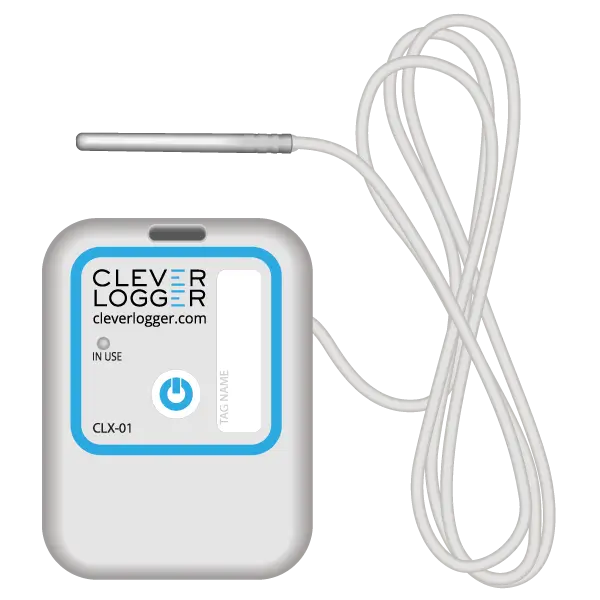
| QUICK SPECS | |
|---|---|
| Model | CLX-01 |
| Type | Temperature only with Probe |
| Temperature Range | -40°C to 60°C Can operate up to 80°C for short periods |
| Humidity Range | N/A |
| Battery Type | CR2450 |
| Battery Life | Replace every 12 months |
| Accuracy | ±0.5℃ (-20℃ to +40℃) ±1℃ (other temperatures) |
| Offline Memory | approx 24 days logging at 5 minute intervals |