

The 4th edition of Strive for 5 represents a significant update to Australia’s vaccine storage guidance.
The biggest change is that automated and cloud-based temperature monitoring systems are now explicitly recognised and encouraged. The new edition also changes the rationale for twice-daily checks, clarifies that Strive for 5 is not used to determine vaccine viability, and introduces more specific monitoring requirements.
Some of the fundamental requirements have not changed. Vaccines still need to be stored between +2°C and +8°C, temperature monitoring remains essential, and providers still need to manually check and record temperatures twice a day.
At the same time, the new edition has not completely adapted its processes to the technology it now recognises. In several places it still applies the same procedures to traditional downloadable data loggers and modern cloud-based monitoring systems.
This article focuses on the changes that are most likely to matter to vaccine providers.
Before looking at what has changed, it is worth pointing out that many of the basic principles of vaccine storage remain unchanged.
Vaccines should still generally be stored between +2°C and +8°C.
The existing exception for a temperature excursion of up to +12°C for 15 minutes or less remains. There is still no equivalent allowance for temperatures below +2°C.
Strive for 5, 4th edition, p. 10
Providers are still required to manually check and record refrigerator temperatures twice each day, generally once at the start of the day and again before closing.
Strive for 5, 4th edition, pp. 11, 18 and 39
Providers are still expected to avoid overstocking refrigerators and to maintain sufficient space for air circulation.
Strive for 5, 4th edition, pp. 11–12
Traditional data logger records are still expected to be reviewed regularly, including the requirement for data logger reports to be reviewed at least weekly.
Strive for 5, 4th edition, pp. 11 and 16
So the 4th edition is not a complete change in direction. Much of the existing cold-chain framework remains in place.
The major changes are in how newer monitoring technologies are recognised and how the role of the provider is described.
This is probably the most important change in the 4th edition.
The glossary now contains a specific definition for an “automated temperature-monitoring system.”
Strive for 5, 4th edition, p. 5
These systems provide real-time temperature information and can notify staff when temperatures move outside acceptable limits.
This is exactly the category that systems such as Clever Logger fit into.
Clever Logger continuously records the temperature of the vaccine fridge and sends the data to the cloud. If the temperature moves outside the configured limits, nominated users can be alerted immediately rather than having to wait until someone physically checks the fridge or downloads a logger.
The importance of this change becomes even clearer on page 13.
Strive for 5 now identifies remote or wireless real-time temperature monitoring with email or SMS alerts as a desirable or optimal feature of a purpose-built vaccine refrigerator setup.
Strive for 5, 4th edition, p. 13
That moves automated monitoring beyond merely being tolerated.
It is now actively encouraged.
Pages 17 and 18 reinforce this further by treating an automated temperature-monitoring system as an alternative to a traditional downloadable data logger.
Strive for 5, 4th edition, pp. 17–18
This is a significant change from the previous edition, where automated monitoring systems were effectively outside the scope of the guidance.
For a system such as Clever Logger, there are some obvious practical advantages.
With a traditional standalone logger, a problem may only be discovered when someone checks the fridge or downloads the logger. With cloud monitoring, an excursion can trigger an immediate notification.
That can make the difference between discovering a refrigerator failure after several hours and being able to respond while the vaccines are still within an acceptable temperature range.
Cloud systems can also automate routine reporting. For example, Clever Logger can email scheduled temperature reports to nominated users each week. This means the weekly report does not have to depend on somebody remembering to connect a logger, download the file and distribute it.
For providers, automated monitoring changes temperature logging from something that is primarily retrospective into something that can be actively managed in real time.
Although automated monitoring systems are now recognised, Strive for 5 still struggles with the practical differences between them and traditional standalone data loggers.
A traditional logger such as a LogTag typically records temperatures internally. Someone periodically connects to or downloads the logger, retrieves the data and reviews the results.
A cloud-based logger such as Clever Logger works differently.
The temperature information is already being collected continuously and is immediately available remotely. More importantly, the system can actively notify users when something is wrong.
If a vaccine refrigerator fails at 2 am, there is little value in discovering that fact when the logger is downloaded several days later.
The real benefit of automated monitoring is that the problem can be reported when it happens.
Despite recognising this difference, Strive for 5 continues to use processes developed for traditional downloadable loggers.
For example, the guidelines still refer to data being downloaded and reviewed weekly.
Strive for 5, 4th edition, pp. 11 and 16
For a traditional standalone logger, that makes sense.
For a cloud-based monitoring system that continuously analyses temperature and immediately notifies users of excursions, the practical value of a weekly review is less obvious. However, providers must still follow Strive for 5 and any additional state or territory requirements that apply to them.
Page 18 improves the wording slightly by recognising that an automated system does not necessarily require temperatures to be downloaded to a computer.
Strive for 5, 4th edition, p. 18
But the underlying weekly-review process remains.
A cloud-based system can also remove some of the human dependency from this process. Rather than relying on somebody to remember that it is Friday and the logger needs to be downloaded, a system such as Clever Logger can automatically generate and email the weekly report.
This does not remove the provider’s responsibility to monitor the refrigerator. It simply makes compliance with the monitoring process easier and more reliable.
The 4th edition therefore represents something of a transition. It recognises modern monitoring technology, but some of its procedures are still based on the previous generation of standalone data loggers.
The requirement to check the refrigerator twice a day has not disappeared.
What has changed is the explanation for why those checks are necessary.
In the previous edition, the emphasis was largely on identifying temperature deviations before vaccines were administered.
The 4th edition gives the requirement a broader purpose.
It explains that manual temperature readings remain necessary even where automated monitoring is installed because electronic monitoring equipment can fail.
Strive for 5, 4th edition, pp. 18 and 39
It also says regular visual checks help staff become familiar with the normal behaviour of the refrigerator and identify signs of a developing problem.
In other words, the manual check is increasingly being treated as an independent backup and operational check, rather than as the primary method of discovering temperature excursions.
That distinction is important when using a system such as Clever Logger.
In a properly configured cloud-monitoring system, an excursion should normally generate a notification long before the next twice-daily manual check.
The manual check then provides redundancy. It confirms that the fridge and the monitoring system are operating as expected and keeps staff engaged with the physical condition of the PBVR.
Another significant change appears in the description of the scope of the guidelines.
Page 8 says Strive for 5 applies to providers involved in the storage, handling and administration of vaccines.
Strive for 5, 4th edition, p. 8
Page 9 then explicitly states that the guidelines do not provide guidance on assessing vaccine viability following a cold chain breach.
Strive for 5, 4th edition, p. 9
Those two statements are important when read together.
Strive for 5 is not intended to be used by a vaccine provider to independently decide whether vaccines are still safe or viable after a cold chain breach.
The provider’s role is to:
The decision about vaccine viability sits outside the scope of Strive for 5.
This is reinforced later in the document, where providers are instructed to contact their state or territory health department for advice following a breach.
Strive for 5, 4th edition, pp. 10, 37 and 41
This is also where good temperature data becomes particularly valuable.
A system such as Clever Logger can provide the detailed temperature history showing when the excursion began, how high or low the temperature went, and how long the excursion lasted.
That information can help the relevant authority assess the incident.
But the logger itself does not determine whether the vaccines remain viable.
The new edition makes it increasingly clear that a thermometer and a data logger are not the same thing.
This distinction appears throughout the monitoring requirements.
For example, page 17 separately requires a minimum/maximum thermometer and either a downloadable data logger or automated temperature-monitoring system.
Strive for 5, 4th edition, p. 17
Page 19 gives a slush-test procedure specifically for checking a thermometer.
Strive for 5, 4th edition, p. 19
Data logger accuracy is handled differently. The logger is required to be checked according to the manufacturer’s recommendations.
Strive for 5, 4th edition, p. 18
So the distinction between the two devices is reasonably clear.
The problem is that Strive for 5 still does not clearly define what it means by a thermometer.
There are potentially several different temperature-measuring devices in a vaccine refrigerator:
Page 11 actually refers to the PBVR temperature display, data logger display or thermometer as separate items.
Strive for 5, 4th edition, p. 11
Later sections refer to inbuilt and portable thermometers without fully explaining the relationship between them.
This creates ambiguity.
The new edition does a better job of separating thermometers from data loggers, but it still does not clearly explain what type of thermometer is required in each circumstance.
The 4th edition gives greater attention to the fact that the temperature inside a vaccine refrigerator is not necessarily uniform.
Section 3.7 discusses identifying cold spots and monitoring different locations within the refrigerator.
Strive for 5, 4th edition, p. 15
It suggests using multiple data loggers or thermometers to assess different areas of the fridge.
The FAQ goes even further and explicitly acknowledges that temperature can vary even across a single shelf.
Strive for 5, 4th edition, p. 39
This is an important acknowledgement.
A single logger reading cannot automatically be assumed to represent every vaccine within the refrigerator.
That makes logger placement and refrigerator temperature mapping increasingly important.
A movable independent logger has an advantage here because it can be positioned at different locations throughout the fridge to understand how temperature varies.
This is another advantage of using a separate monitoring system rather than relying entirely on an inbuilt logger fixed in one location.
However, the guidance still has limitations. It does not define how much temperature variation within a refrigerator is acceptable. That is an issue we will explore separately in What’s Still Wrong with Strive for 5, 4th Edition.
The new edition also contains several more specific requirements relating to temperature monitoring.
The logging interval is now clearly specified as 5 minutes in key sections of the document.
Strive for 5, 4th edition, pp. 17 and 37
Automated temperature-monitoring systems are explicitly recognised alongside traditional data loggers.
Strive for 5, 4th edition, pp. 17–18
The guidelines also make it clear that automated systems should provide alert capability and that local procedures should exist for responding to those alerts.
Strive for 5, 4th edition, pp. 13–14
This is particularly important.
There is little benefit in having immediate cloud alerts if nobody has responsibility for responding to them.
A good automated monitoring setup therefore needs both the technology and an escalation procedure: who receives the first alert, what happens if they do not respond, and who is ultimately responsible for dealing with a fridge failure.
Systems such as Clever Logger can provide the immediate notification mechanism, but the organisation still needs an appropriate response procedure around it.
The new edition therefore gives providers clearer guidance about the basic characteristics expected from modern monitoring.
However, one technical specification remains notably absent: Strive for 5 does not specify a minimum numerical accuracy requirement for data loggers.
That issue deserves separate consideration.
The new edition introduces a clearer requirement for what should happen after power is restored.
Previously, providers were told to monitor the refrigerator closely, for example hourly, until its temperature stabilised.
The 4th edition is more specific.
It requires the PBVR to be monitored hourly for 4 hours after power is restored, before returning to the normal twice-daily monitoring schedule.
Strive for 5, 4th edition, p. 25
That is a relatively small change, but it removes ambiguity and gives providers a definite monitoring period.
Automated monitoring is particularly useful during this period because it provides a continuous record of the fridge returning to normal operation rather than relying solely on four individual hourly readings.
The 4th edition introduces a dedicated section dealing with transporting vaccines from one PBVR to another.
Strive for 5, 4th edition, p. 23
This is generally discouraged, but the guidelines recognise that it may be necessary for organisations operating across multiple locations.
Where vaccines are transferred, temperatures should be recorded:
This provides clearer guidance for organisations moving stock between clinics or facilities.
There are also several changes toward the end of the document.
The recommended self-audit frequency has changed from at least every 12 months to every 6–12 months, or as required.
Strive for 5, 4th edition, p. 35
The new edition also notes that some vaccines may arrive with only 9–12 months of shelf life remaining, reinforcing the need for appropriate stock rotation.
Strive for 5, 4th edition, p. 35
The cold chain breach procedure now explicitly refers to continuous data logging at 5-minute intervals.
Strive for 5, 4th edition, p. 37
The information expected when reporting a breach is also more clearly defined and includes:
Strive for 5, 4th edition, p. 37
The timing of data retrieval has also changed. Rather than simply downloading the logger before contacting the health department, the new wording refers to downloading the breach-period data once the refrigerator has returned to the +2°C to +8°C range.
Cloud-based systems can make this process considerably easier because the historical temperature record is already available without having to physically retrieve the logger.
The report can show precisely what happened before, during and after the incident and can be supplied as part of the breach investigation.
The most important change in Strive for 5, 4th edition is not a particular temperature limit or logging interval.
It is the way the guidelines now view temperature monitoring.
The previous edition was largely written around standalone thermometers and downloadable data loggers.
The new edition explicitly recognises continuous, automated and remotely connected monitoring systems.
It even encourages them.
Systems such as Clever Logger illustrate why this change matters.
Instead of simply recording a fridge failure so that it can be discovered later, cloud monitoring can tell someone immediately that something has gone wrong.
Instead of depending on someone remembering to download and distribute a weekly report, that report can be automatically emailed to the appropriate people.
And instead of the temperature record being locked inside a logger sitting in the refrigerator, the information can be available remotely when it is needed.
At the same time, Strive for 5 has retained many procedures originally designed for traditional loggers, creating some awkward overlaps between old and new technology.
There are also still areas where the technical guidance is unclear or incomplete.
But the direction is obvious.
Vaccine temperature monitoring is moving away from periodically discovering what happened and towards continuously knowing what is happening.
For vaccine providers, that is probably the most important change in Strive for 5, 4th edition.
To prove it, we’ll send you a Starter Kit to try out for a whole month.
Set it up, have a play, explore the features – obligation free.
If you love it, just let us know.
If not, just send it back.
| QUICK SPECS | |
|---|---|
| Model | CLD-01 |
| Type | Temperature only with Dual Sensors |
| Temperature Range | Internal sensor: -23°C to +60°C External sensor: -40°C to +80°C |
| Humidity Range | N/A |
| Battery Type | CR2450 |
| Battery Life | Replace every 12 months |
| Accuracy |
Internal Sensor: ±0.3℃ (0℃ to +60℃) ±0.3℃ to ±0.7℃ (other temperatures) External Probe: ±0.5℃ (-20℃ to +40℃) ±1℃ (other temperatures) |
| Offline Memory | approx 24 days logging at 5 minute intervals |
| QUICK SPECS | |
|---|---|
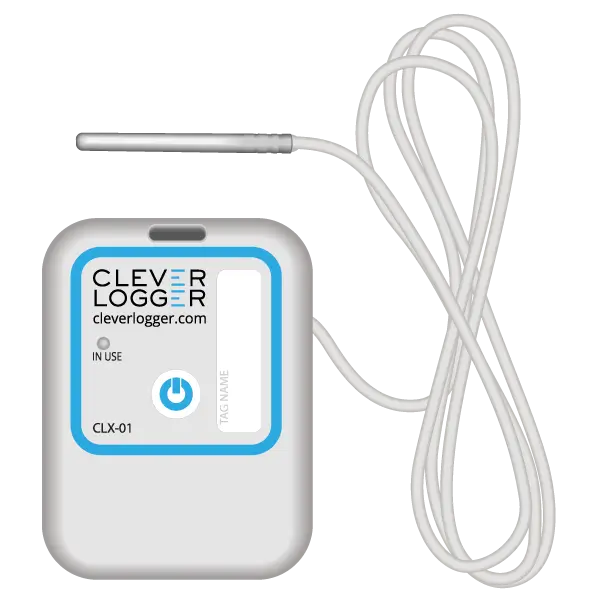
| Model | CLX-01 |
| Type | Temperature only with Probe |
| Temperature Range | -40°C to 60°C Can operate up to 80°C for short periods |
| Humidity Range | N/A |
| Battery Type | CR2450 |
| Battery Life | Replace every 12 months |
| Accuracy | ±0.5℃ (-20℃ to +40℃) ±1℃ (other temperatures) |
| Offline Memory | approx 24 days logging at 5 minute intervals |