

Most beauty clinics take product storage seriously.
You know your injectables are valuable. You know they need to be kept cold. You know that a compromised product is not something you want anywhere near a client.
But there is one part of the process that often gets treated as “good enough”.
The fridge.
In many beauty clinics and aesthetic practices, Botox and other temperature-sensitive injectables are stored in small domestic fridges. Sometimes they are stored in compact “bar fridges” or dorm-room style fridges. Occasionally they are stored in the same kind of fridge you would use for drinks, lunches or spare milk.
That is where the risk starts.
A domestic fridge is designed to keep food cold.
It is not designed to maintain a tight, reliable temperature range for expensive temperature-sensitive medicines.
That distinction matters.
Purpose-built medical and drug fridges are generally designed with better air circulation, tighter temperature control and more even temperature distribution. Many domestic fridges do not have the same fan-forced regulation. That means the temperature inside the fridge can vary depending on where the product is placed, how often the door is opened, how full the fridge is, and how well the fridge is maintained.
The display on the fridge, if it has one, does not tell the whole story.
It might tell you the temperature at one point in time, in one part of the fridge, under one set of conditions. It does not tell you what happened overnight. It does not tell you whether the back corner dropped too low. It does not tell you whether the top shelf warmed up every time the door was opened. It does not tell you whether the fridge drifted out of range for two hours on a hot afternoon.
For a clinic storing injectables, that is not enough information.
Some small domestic fridges include a tiny freezer section inside the same compartment.
These are particularly poor choices for storing injectables.
The area near the freezer section can become much colder than the rest of the fridge. Products stored too close to it may be exposed to freezing or near-freezing conditions, even while the rest of the fridge appears acceptable.
This is one of the problems with relying on “the fridge is set correctly” as your safety check. The setting is not the same as the actual temperature around the product.
If you are buying a fridge for injectables, avoid this style completely.
If you already have one, do not store products near the freezer section. Better still, replace it with a more suitable fridge.
A nearly empty fridge can change temperature quickly.
Every time the door opens, warm air enters. In a fridge with very little inside it, there is not much cold mass to help buffer that change. The air warms quickly, the compressor kicks in, the fridge cools again, and the temperature continues to swing up and down.
One practical way to reduce this effect is to place bottles of water in the empty spaces.
The water acts as thermal mass. It does not fix a bad fridge, but it can help reduce rapid temperature swings caused by door openings, compressor cycles or short interruptions. It can also help the fridge recover more steadily after the door has been opened.
A few important points:
A domestic fridge can become less reliable over time.
Door seals wear out. Dust builds up around the compressor. Staff leave the door slightly ajar. Products get pushed to the back wall. The fridge is moved into a warm room or placed too close to a wall.
None of these things feel dramatic at the time, but they can all affect temperature control.
For a clinic fridge, it is worth checking the basics regularly:
These are sensible habits. They reduce risk.
But they still do not answer the most important question.
What temperature is the fridge actually maintaining?
This is the real issue.
A domestic fridge might be fine most of the time.
It might also be drifting too warm every afternoon when the sun hits it.
It might be dipping too cold overnight.
It might have one shelf that is safe and another that is not.
It might be reliable in winter and unreliable in summer.
Without continuous monitoring, you do not really know.
Manual temperature checks are better than nothing, but they only capture the moment someone checks. A staff member can record a perfectly normal temperature at 9:00 am and still miss a breach that happened at 2:00 am.
That is a major weakness when the products in the fridge are expensive, temperature-sensitive and being injected into clients.
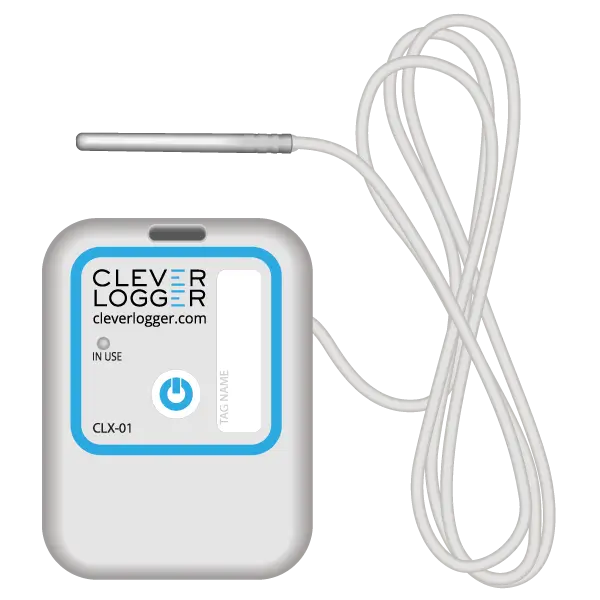
Clever Logger gives you a clear picture of what is actually happening inside the fridge.
It records the temperature continuously, so you can see whether your fridge is stable, whether it fluctuates, and whether certain times of day are a problem.
More importantly, it alerts you when the temperature goes out of range.
That means you are not discovering a problem hours later. You are not relying on someone remembering to check a thermometer. You are not hoping the fridge behaved itself overnight.
And you can act quickly.
For beauty clinics and aesthetic nurses, this matters for three reasons.
That last point is easy to underestimate.
Clients may not ask about fridge monitoring, but they do care about safety. Being able to say that your injectables are continuously monitored is a strong professional signal. It shows that your clinic does not leave product storage to chance.
Not every clinic is going to install a purpose-built drug fridge tomorrow.
That is the reality.
But if you are using a domestic fridge, you should at least know how it behaves.
Does it stay within range overnight?
Does it warm up during busy treatment days?
Does the temperature change when the room gets hot?
Does it recover quickly after the door is opened?
Are there cold spots or warm spots?
These are not questions you can answer by looking at the dial.
You answer them by monitoring the fridge.
If you store Botox or other injectables in a clinic fridge, do not assume the fridge is doing its job just because it feels cold.
Avoid small fridges with freezer compartments. Keep products away from cold plates and back walls. Check seals. Keep the compressor clean. Add water bottles to empty spaces if you can do so without blocking airflow.
But above all, monitor the temperature.
A Clever Logger turns your fridge from a guessing game into something you can actually manage. It gives you a record of what happened, alerts you when something goes wrong, and helps you prove that your products have been stored with care.
For a clinic that relies on trust, that is not a small thing.
To prove it, we’ll send you a Starter Kit to try out for a whole month.
Set it up, have a play, explore the features – obligation free.
If you love it, just let us know.
If not, just send it back.
| QUICK SPECS | |
|---|---|
| Model | CLD-01 |
| Type | Temperature only with Dual Sensors |
| Temperature Range | Internal sensor: -23°C to +60°C External sensor: -40°C to +80°C |
| Humidity Range | N/A |
| Battery Type | CR2450 |
| Battery Life | Replace every 12 months |
| Accuracy |
Internal Sensor: ±0.3℃ (0℃ to +60℃) ±0.3℃ to ±0.7℃ (other temperatures) External Probe: ±0.5℃ (-20℃ to +40℃) ±1℃ (other temperatures) |
| Offline Memory | approx 24 days logging at 5 minute intervals |
| QUICK SPECS | |
|---|---|
| Model | CLX-01 |
| Type | Temperature only with Probe |
| Temperature Range | -40°C to 60°C Can operate up to 80°C for short periods |
| Humidity Range | N/A |
| Battery Type | CR2450 |
| Battery Life | Replace every 12 months |
| Accuracy | ±0.5℃ (-20℃ to +40℃) ±1℃ (other temperatures) |
| Offline Memory | approx 24 days logging at 5 minute intervals |