We can send your loggers off for special testing in a lab. The lab will give you a certificate of accuracy.
But do you need it?
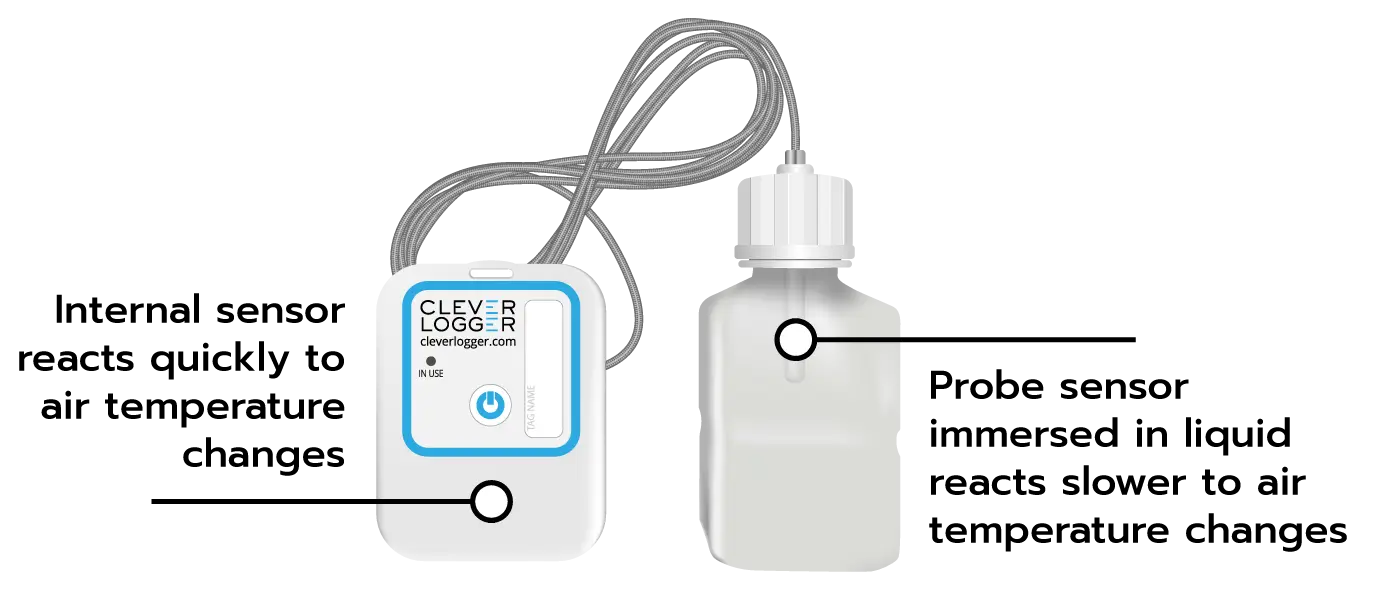
Latency is the time it takes for something to change temperature, and different substances have vastly different latencies. If you apply a heat source to air, the air quickly becomes hot. If you apply a heat source to a liquid, it will heat up, but much more slowly.
So, if your logger is measuring air temperature, you will see rapid fluctuations in temperatures. Whereas, if your logger is measuring a liquid, those fluctuations will be much less pronounced.
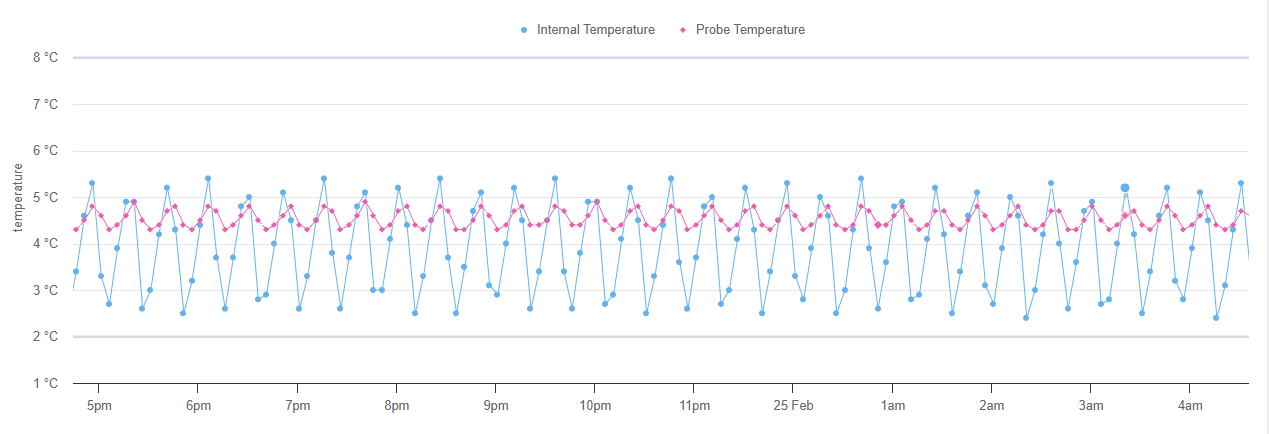
In the graph below, we can see the Dual Sensor logger in action. The blue line represents air temperature, measured by the loggers internal sensor, while the pink line represents the temperature of the glycol in the vial, measured by the external probe.

You can see that the variation between minimum and maximum temperatures is much lower for the liquid temperature than for the air temperature.
This logger is specifically recommended for vaccine fridges
The Clever Logger logger has two jobs:
If we configure the Dual Sensor logger so that the alarms are triggered by the air temperature sensor, we will be notified immediately if the temperature goes outside our set limits.
However, since we are interested in the temperatures of the liquid vaccines, it is perfectly acceptable to log the temperature of the glycol liquid in the vial.
If the temperature starts to rise, we will find out about it from the air temperature sensor well before the liquid-immersed sensor reaches 8°, and hopefully in time to remedy the problem before the log shows a breach.
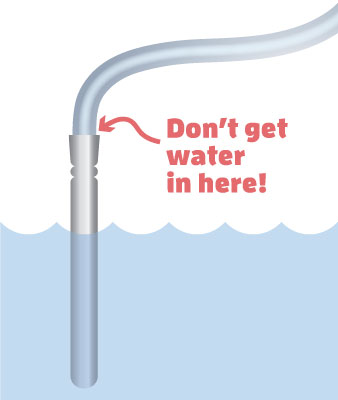
Note that only the metal tip of the probe is submersible. If liquid enters the join between the cable and the probe tip, the probe can be damaged.
Probably not.
It’s certainly not a requirement for storing vaccines.
In general, the only people who request additional accuracy certification are people running clinical scientific trials.
The certificates start from $121 per logger and add 7-10 business days to the delivery time.
| QUICK SPECS | |
|---|---|
| Model | CLD-01 |
| Type | Temperature only with Dual Sensors |
| Temperature Range | Internal sensor: -23°C to +60°C External sensor: -40°C to +80°C |
| Humidity Range | N/A |
| Battery Type | CR2450 |
| Battery Life | Replace every 12 months |
| Accuracy |
Internal Sensor: ±0.3℃ (0℃ to +60℃) ±0.3℃ to ±0.7℃ (other temperatures) External Probe: ±0.5℃ (-20℃ to +40℃) ±1℃ (other temperatures) |
| Offline Memory | approx 24 days logging at 5 minute intervals |
| QUICK SPECS | |
|---|---|
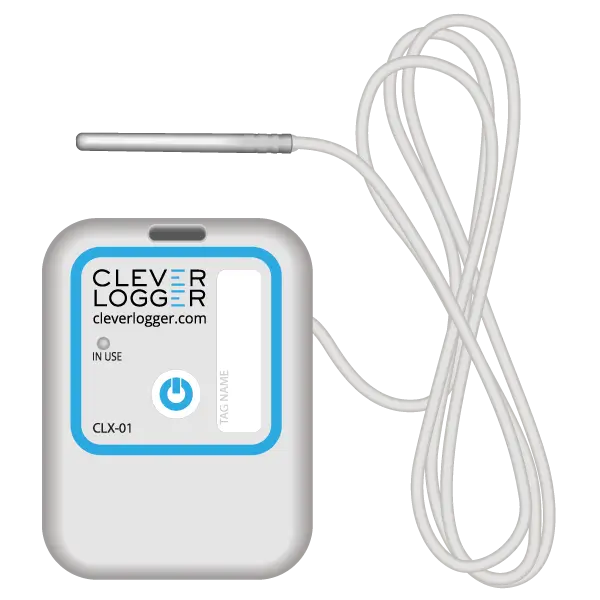
| Model | CLX-01 |
| Type | Temperature only with Probe |
| Temperature Range | -40°C to 60°C Can operate up to 80°C for short periods |
| Humidity Range | N/A |
| Battery Type | CR2450 |
| Battery Life | Replace every 12 months |
| Accuracy | ±0.5℃ (-20℃ to +40℃) ±1℃ (other temperatures) |
| Offline Memory | approx 24 days logging at 5 minute intervals |
The National Association of Testing Authorities (NATA) is the recognised national accreditation authority for analytical laboratories and testing service providers in Australia. It is an independent, not-for-profit organisation that provides independent assurance of technical competence.
NATA accredits organisations to perform testing and inspection activities for their products and services. This gives consumers the assurance they need to make safe, healthy and reliable choices .
To prove it, we’ll send you a Starter Kit to try out for a whole month.
Set it up, have a play, explore the features – obligation free.
If you love it, just let us know.
If not, just send it back.